 Mathew K Analytics
ML algorithms deep dive
A free 12-lesson course. Every lesson has a video walkthrough and a Jupyter notebook you can download or open in Google Colab; 12 lessons include real datasets. Tools covered: scikit-learn, pandas, NumPy, Matplotlib, SciPy, statsmodels.
- Lessons12
- Videoabout 4 hours
- LevelIntermediate
- PriceFree
- Datasets12
About this course
ML algorithms deep dive is a free intermediate course with 12 video lessons (about 4 hours of video in total). It starts with “Linear Regression from Scratch in Python | ML Algorithms #1” and finishes with “Comparing Every ML Algorithm: Capstone Project | ML Algorithms #12”. Every lesson comes with the exact Jupyter notebook used in the video, and 12 of them include the dataset, so you can follow along with the same data.
Along the way you'll use scikit-learn, pandas, NumPy, Matplotlib, SciPy and statsmodels.
It suits learners who already know basic Python (variables, lists, loops and functions) and want to apply it to real problems.
Course outline
- Linear Regression from Scratch in Python | ML Algorithms #1 – The first video of a 12-part series: one real algorithm per video, covered in full depth. Real classic car data: fuel economy, weight,…
- Logistic Regression for Classification | ML Algorithms #2 – The first real classification algorithm. Real diagnostic measurements from the Wisconsin breast cancer dataset, a genuine, widely-used…
- K-Nearest Neighbours (KNN) Explained | ML Algorithms #3 – A classifier with no training phase at all. Real flower measurements from the classic Iris dataset, plus a real callback to breast cancer.…
- Decision Trees: How They Really Work | ML Algorithms #4 – An algorithm that explains its own real reasoning. Real mushroom characteristics, labeled genuinely edible or genuinely poisonous. Let's…
- Random Forests Explained with Python | ML Algorithms #5 – Fixing a single tree's instability by growing many of them. Real chemical measurements from 178 real wines, across three real cultivars.…
- Gradient Boosting Explained Step by Step | ML Algorithms #6 – A genuinely different way to combine many real trees. Real patient measurements predicting real diabetes disease progression. Let's get…
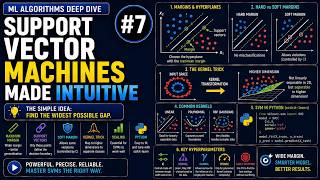
- Support Vector Machines Made Intuitive | ML Algorithms #7 – Revisiting real breast cancer data for a direct rematch against video two. Real diagnostic measurements, same real patients, same real…
- Naive Bayes Classifier Explained | ML Algorithms #8 – Revisiting real mushroom data for another direct algorithm rematch. Real physical mushroom traits, same real dataset, same real question,…
All 12 lessons
 25 min
Linear Regression from Scratch in Python | ML Algorithms #1
 21 min
Logistic Regression for Classification | ML Algorithms #2
 20 min
K-Nearest Neighbours (KNN) Explained | ML Algorithms #3
 17 min
Decision Trees: How They Really Work | ML Algorithms #4
 17 min
Random Forests Explained with Python | ML Algorithms #5
 17 min
Gradient Boosting Explained Step by Step | ML Algorithms #6
 17 min
Support Vector Machines Made Intuitive | ML Algorithms #7
 16 min
Naive Bayes Classifier Explained | ML Algorithms #8
 19 min
K-Means Clustering in Python | ML Algorithms #9
 15 min
Hierarchical Clustering & Dendrograms | ML Algorithms #10
 15 min
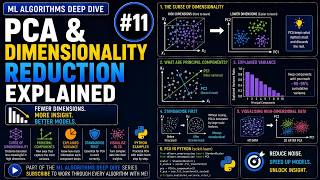
PCA & Dimensionality Reduction Explained | ML Algorithms #11
 15 min
Comparing Every ML Algorithm: Capstone Project | ML Algorithms #12
Frequently asked questions
Is the ML algorithms deep dive course free?
Yes. All 12 videos, notebooks and datasets are free, with no sign-up.
Do I need to install anything?
No. You can open each notebook in Google Colab in your browser, or download it and run it in Jupyter or VS Code with Anaconda installed.
How long does the ML algorithms deep dive course take?
The videos add up to about 4 hours. Most learners take one to two lessons a day, so plan on 2 to 3 weeks if you code along.
What level is it?
Intermediate. It suits learners who already know basic Python (variables, lists, loops and functions) and want to apply it to real problems.