 Mathew K Analytics
OpenAI
A free 14-lesson course. Every lesson has a video walkthrough and a Jupyter notebook you can download or open in Google Colab. Tools covered: OpenAI, NumPy, JSON.
- Lessons14
- Videoabout 4 hours
- LevelBeginner to intermediate
- PriceFree
About this course
OpenAI is a free beginner to intermediate course with 14 video lessons (about 4 hours of video in total). It starts with “How to Install and Set Up the OpenAI Python SDK: A Step-by-Step Guide” and finishes with “How to Diagnose and Resolve Common OpenAI API Issues for Reliable Integration”. Every lesson comes with the exact Jupyter notebook used in the video, so you can run every step yourself.
Along the way you'll use OpenAI, NumPy and JSON.
It suits learners who already know basic Python (variables, lists, loops and functions) and want to apply it to real problems.
Course outline
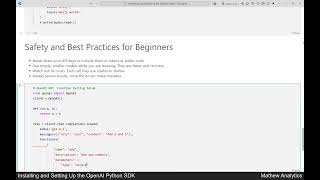
- How to Install and Set Up the OpenAI Python SDK: A Step-by-Step Guide – Welcome to your first steps with the OpenAI API in Python. This lesson will help you set up, understand, and safely use the API. You will…
- Mastering OpenAI Models: Enhance AI Responses with Python Embeddings – Welcome to your guide for getting started You will learn step by step how to use the OpenAI API Let us get started! The OpenAI API lets…
- Understanding Chat Completions API: Building Conversational AI with OpenAI – Learn how to use the OpenAI API, Get started with chat completions, embeddings, and more. No previous experience needed! The API connects…
- Master OpenAI Embeddings API with Effective Python Error Handling – This lesson will show how to use the OpenAI API for text embeddings in Python. No prior AI or coding experience is needed. Embeddings are…
- Understanding Vector Search and Semantic Similarity in AI and Machine Learning – Welcome to your beginner friendly guide to using the OpenAI API. This lesson shows you how you can talk to advanced AI using code. You…
- How to Use OpenAI Whisper for Accurate Speech-to-Text Transcription – Welcome to your hands-on beginner lesson. We will explore the OpenAI Python API together. You will learn how to use the API for tasks like…
- How to Build Text-to-Speech Systems Using GPT and OpenAI APIs for Christian Teaching Tools – Welcome to your first lesson on using the OpenAI API with Python. In this session, you will learn about what the OpenAI API is and why it…
- OpenAI Function Calling Explained with Error Handling in Python – Welcome to your hands-on beginner lesson. You will learn how to use the OpenAI API for advanced function calling. We will type code step…
All 14 lessons
 20 min
How to Install and Set Up the OpenAI Python SDK: A Step-by-Step Guide
 20 min
Mastering OpenAI Models: Enhance AI Responses with Python Embeddings
 17 min
Understanding Chat Completions API: Building Conversational AI with OpenAI
 16 min
Master OpenAI Embeddings API with Effective Python Error Handling
 25 min
Understanding Vector Search and Semantic Similarity in AI and Machine Learning
 18 min
How to Use OpenAI Whisper for Accurate Speech-to-Text Transcription
 15 min
How to Build Text-to-Speech Systems Using GPT and OpenAI APIs for Christian Teaching Tools
 4 min
OpenAI Function Calling Explained with Error Handling in Python
 23 min
Mastering OpenAI Tools API: Seamlessly Integrate External Apps with Python
 23 min
Master the OpenAI Assistants API: Build Interactive & Intelligent Python Applications
 25 min
Managing Errors and Rate Limits in OpenAI API Integrations for Reliable Applications
 4 min
OpenAI Python Error Handling and API Best Practices
 22 min
How to Build a Simple AI Assistant Using OpenAI and Python: Step-by-Step Tutorial
 16 min
How to Diagnose and Resolve Common OpenAI API Issues for Reliable Integration
Frequently asked questions
Is the OpenAI course free?
Yes. All 14 videos, notebooks are free, with no sign-up.
Do I need to install anything?
No. You can open each notebook in Google Colab in your browser, or download it and run it in Jupyter or VS Code with Anaconda installed.
How long does the OpenAI course take?
The videos add up to about 4 hours. Most learners take one to two lessons a day, so plan on 2 to 4 weeks if you code along.
What level is it?
Beginner to intermediate. It suits learners who already know basic Python (variables, lists, loops and functions) and want to apply it to real problems.