 Mathew K Analytics
Python data types deep dive
A free 12-lesson course. Every lesson has a video walkthrough and a Jupyter notebook you can download or open in Google Colab. Tools covered: collections.
- Lessons12
- Videoabout 5 hours
- LevelIntermediate
- PriceFree
About this course
Python data types deep dive is a free intermediate course with 12 video lessons (about 5 hours of video in total). It starts with “Python Integers Explained: Bases, Division & Modulo | Data Types #1” and finishes with “Python Bytearrays Explained: Mutable Binary Data | Data Types #12”. Every lesson comes with the exact Jupyter notebook used in the video, so you can run every step yourself.
Along the way you'll use collections.
It suits learners who already know basic Python (variables, lists, loops and functions) and want to apply it to real problems.
Course outline
- Python Integers Explained: Bases, Division & Modulo | Data Types #1 – Covering every built-in Python data type in full depth, one type per video. This video is entirely about int: every literal form, every…
- Python Floats Explained: Precision, Rounding & Pitfalls | Data Types #2 – The second numeric type, and where it genuinely diverges from int. Every literal form, every operator, the precision problem that trips up…
- Python Complex Numbers Explained: Real & Imaginary | Data Types #3 – The third and final built-in numeric type. Every literal form, every operator, all three public complex methods, and the full cmath module…
- Python Booleans & None Explained: Truthy vs Falsy | Data Types #4 – Bool and None, two small types with outsized influence on how every if statement, loop, and comparison in Python actually behaves.…
- Python Strings Explained: Slicing, Methods & f-Strings | Data Types #5 – Str, the largest built-in type by method count, and the most-used type in nearly every real Python program. Every literal form, indexing…
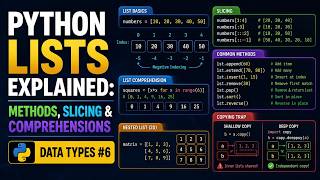
- Python Lists Explained: Methods, Slicing & Comprehensions | Data Types #6 – List, Python's mutable, general-purpose sequence, and the workhorse type of everyday Python code. Construction, indexing and slicing, all…
- Python Tuples Explained: Immutable, Fast & Unpackable | Data Types #7 – Tuple, list's immutable cousin. Only two public methods, but a surprising amount of genuinely important behavior around unpacking,…
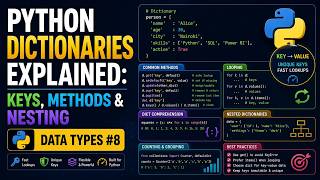
- Python Dictionaries Explained: Keys, Methods & Nesting | Data Types #8 – Dict, Python's key-value mapping type and one of the most-used data structures in the entire language. Construction, access, all eleven…
All 12 lessons
 30 min
Python Integers Explained: Bases, Division & Modulo | Data Types #1
 27 min
Python Floats Explained: Precision, Rounding & Pitfalls | Data Types #2
 20 min
Python Complex Numbers Explained: Real & Imaginary | Data Types #3
 23 min
Python Booleans & None Explained: Truthy vs Falsy | Data Types #4
 35 min
Python Strings Explained: Slicing, Methods & f-Strings | Data Types #5
 21 min
Python Lists Explained: Methods, Slicing & Comprehensions | Data Types #6
 20 min
Python Tuples Explained: Immutable, Fast & Unpackable | Data Types #7
 21 min
Python Dictionaries Explained: Keys, Methods & Nesting | Data Types #8
 18 min
Python Sets Explained: Union, Intersection & Difference | Data Types #9
 14 min
Python Frozensets Explained: Immutable Sets in Practice | Data Types #10
 28 min
Python Bytes Explained: Binary Data, Encoding & Decoding | Data Types #11
 24 min
Python Bytearrays Explained: Mutable Binary Data | Data Types #12
Frequently asked questions
Is the Python data types deep dive course free?
Yes. All 12 videos, notebooks are free, with no sign-up.
Do I need to install anything?
No. You can open each notebook in Google Colab in your browser, or download it and run it in Jupyter or VS Code with Anaconda installed.
How long does the Python data types deep dive course take?
The videos add up to about 5 hours. Most learners take one to two lessons a day, so plan on 2 to 3 weeks if you code along.
What level is it?
Intermediate. It suits learners who already know basic Python (variables, lists, loops and functions) and want to apply it to real problems.